
Most account-based marketing (ABM) programs die quietly around month nine. Leadership looks at the spend, asks what it returned, and the team points to activity. Emails sent. Accounts touched. A webinar or two. That is usually the moment the program gets cut. Not because ABM does not work, but because it was run as a campaign instead of a business strategy.
I keep seeing the same pattern, and I keep coming back to the same conclusion. As one revenue leader framed it recently:
ABM is a go-to-market strategy, not a short-term pipeline fix (Garza, 2026)
I agree with her completely. I also want to take it one step further, because agreeing with the mindset is easy and living by it is where most teams fall apart. The programs that survive, and the ones that actually get expanded, are decided before launch on the math. The ones that get cut were decided after launch on a feeling.
Here is how I set ABM up so it holds when leadership pressure tests it.
Start with the strategy, not the tactics
When I treat ABM as a business strategy, the work looks nothing like a campaign calendar. It looks like a plan for how the whole revenue engine goes after the accounts that matter most.
That starts with alignment. Sales and marketing agree on the two or three highest-value revenue verticals and the priority accounts inside them, and they agree in the same room, not in separate spreadsheets. From there, the buyer journey gets built around people, not features. Each stakeholder in the buying committee has different pressures, and the messaging speaks to their business priorities rather than our product roadmap.
The execution is multi-threaded by design. Relationship mapping, coordinated outreach, and a deliberate presence across the entire committee, so no single champion is carrying the deal alone. Every touch is meant to build relationship equity through relevant, connected interactions, which is the opposite of the disconnected blast of activity that most teams call ABM.
And the way you keep score changes. You measure buying group progression first, meaning real movement toward a decision, not opens and clicks. Pipeline and revenue are the outcomes of that progression, not the starting metrics. When you lead with genuine progression, revenue follows in a way you can actually explain.
Not all ABM is the same. Match the model to your economics.
Before you touch the math, decide which version of ABM you are actually running, because there is more than one. It helps to picture it as a pyramid.
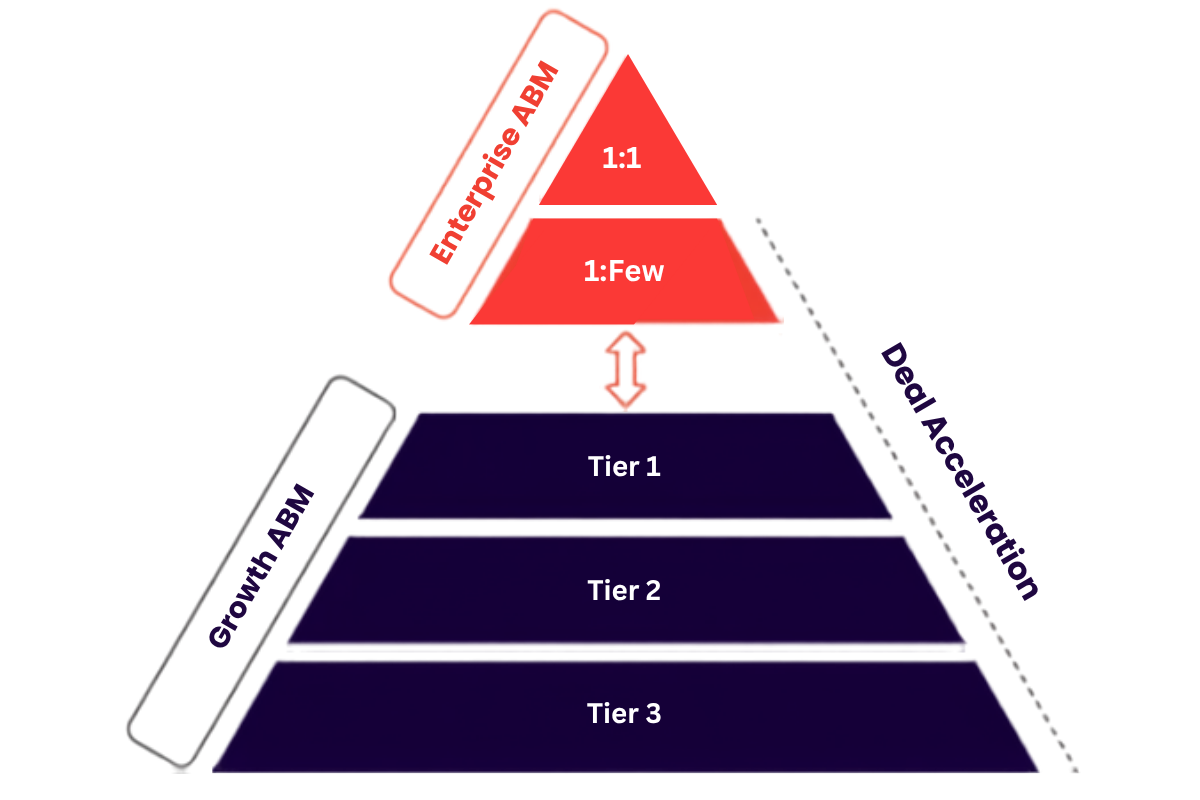
At the top sits Enterprise ABM. This is the one-to-one motion, where a whole program is built around a single named account, and the one-to-few motion, where you run a tailored play against a small cluster of very similar accounts. It is the most customized and most expensive work per account, so it typically makes sense only in organizations with a high average contract value, where the size of the deal justifies the investment.
At the base sits Growth ABM. This is the tiered, one-to-many motion, usually split across Tier 1, Tier 2, and Tier 3 by account priority. It is the most frequently deployed model because it scales coverage across many accounts at once and becomes a necessity when the average contract value is lower or when the go-to-market team is running lean.
Running down the side of the pyramid is the throughline that ties every tier together: deal acceleration. Whether you are building a single one-to-one program or scaling Growth ABM across hundreds of accounts, the point is the same. Move the right accounts through the buying committee faster.
Here is why this belongs before the financial model, not after. The tier you choose sets your cost per account, and that one decision reshapes every number that follows. The $150 to $300 per-account air cover I use as a planning range is a Growth ABM figure. A true one-to-one enterprise program can cost many times that per account, which is exactly why you only run it where the contract value earns it back. Pick your model first. Then build the cost model around the model you picked.
The first question is financial, not creative
I have looked at a lot of ABM programs, and the biggest predictor of whether one survives is not the ICP, the messaging, or the team. It is the math. The first question worth asking before you spend a dollar is simple. Walk me through the numbers. What are we actually buying here?
Most teams cannot answer that with a straight face. The ones that can are the ones that get renewed. So build the answer before you launch, in five steps.
Step one: build the cost model
Total ABM investment breaks into three buckets, and you need all three or your ROI is fiction.
Media spend is the air cover. LinkedIn, connected TV, programmatic, and direct mail. A reasonable planning range is $150 to $300 per target account per month, so a 100-account program lands at a minimum of $15,000 to $30,000 per month.
The tech stack includes your intent data, the ABM platform, and enrichment tools. Annualize the cost and divide it among the programs it supports, so no single program carries the whole bill.
People cost is the one everyone forgets. Take the percentage of SDR, marketing, and operations time genuinely dedicated to ABM, then multiply each burdened salary by that time allocation.
Add the three together, and you have your total program cost. Not a guess. A number.
Step two: model your expected pipeline
Once you know the cost, model the return with a formula you can defend:
Target accounts multiplied by expected engagement rate multiplied by meeting conversion multiplied by opportunity conversion multiplied by average deal size equals expected pipeline.
Here is a worked example to make it concrete. Start with 100 target accounts. Assume a 25% engagement rate, resulting in 25 engaged accounts. Apply a 40% meeting conversion, which is 10 meetings. Apply a 70% opportunity conversion, which is 7 opportunities. At a $75,000 average deal size, that models out to roughly $525,000 in pipeline.
Step three: calculate program ROI
Now turn pipeline into a return leadership recognizes.
Pipeline ROI is expected pipeline divided by total program cost. If the program costs $50,000 and models $525,000 in pipeline, that is a 10.5 times pipeline ROI.
But leadership does not close pipeline. They close revenue, so give them the number they actually care about. Revenue ROI is expected pipeline multiplied by your historical close rate, divided by total program cost. Take that same $525,000, apply a 30% close rate, and you get $157,500 in expected revenue. At a $50,000 cost, that is a 3.15x revenue ROI. Still a strong story, and a far more honest one.
Step four: build the sensitivity table
This is the step that separates operators from everyone else. Never walk in with a single number, because the first thing a good CFO does is ask what happens if you are wrong.
Show three scenarios instead. A conservative case at something like 20% engagement and a 25% close rate. A base case at 25% engagement and a 30% close rate. An aggressive case at 35% engagement and a 35% close rate. Map each one to both pipeline and revenue ROI.
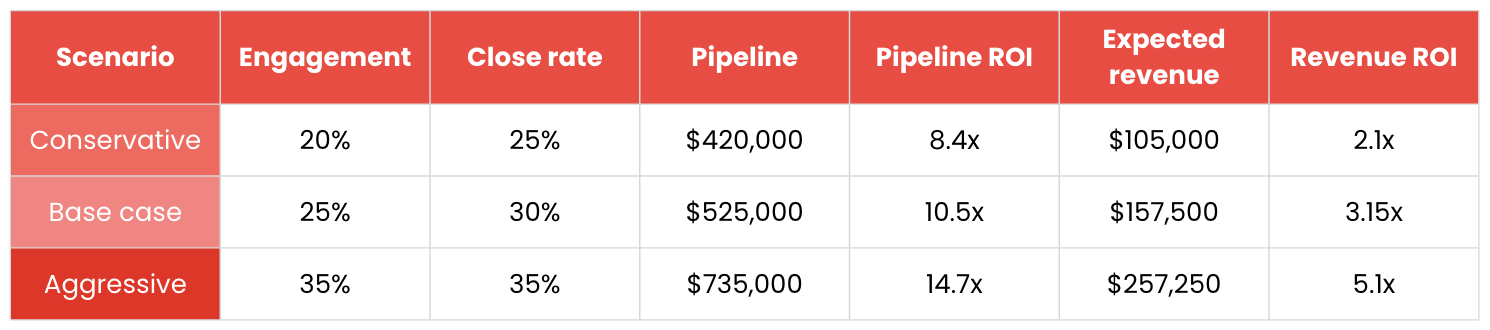
When leadership asks what happens if it does not work, you already have the answer on the page. That is what earns you the budget.
Step five: tie it to your existing benchmarks
Finally, connect ABM to numbers the business already trusts. Pull your historical data. What is your current cost per opportunity from other channels? What is your average CAC payback? What is your LTV to CAC ratio by segment?
Then show how ABM compares. If your current cost per opportunity is $8,000 and ABM is modeled to deliver at $7,100, that is the story. The pitch is never that ABM is exciting. The pitch is that ABM delivers pipeline at a lower cost per opportunity than your current mix, against benchmarks the business has already agreed to.
Why this matters
ABM is not about generating more activity. It is about building trust, creating relationship equity, and aligning every customer-facing team around the accounts that matter most. But none of that survives contact with a budget review unless you did the financial work first.
Programs that launch with a real cost model, a defensible pipeline forecast, an honest ROI, a sensitivity table, and a benchmark comparison do not get cut at month nine. They get expanded. Treat ABM like a business case, because that is exactly what it is.
References
Garza, R. E. (2026, July). ABM is a go-to-market strategy, not a short-term pipeline fix .